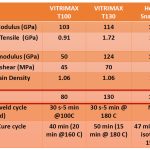
In previous posts, the chemistry, and viscoelastic properties of vitrimers were presented. This post will discuss how vitrimers can be used in production to form thermoset parts/composites that can be reprocessed at end-of-life. For a network that contains covalent adaptive networks, as the temperature increases, exchange reactions such as transesterification in epoxy ... [Click to Continue...]
Thermoset Re-use and Recycling – Part Four
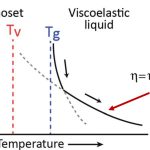
The previous post described the work of Liebler [1] who showed both epoxy carboxylic acid networks and epoxy anhydride networks contained covalent adaptive networks that underwent transesterification reactions at elevated temperatures (i.e. vitrimers). The unique discovery in both epoxy systems was the viscoelastic behavior at elevated temperatures. Vitrimers are covalently ... [Click to Continue...]
Thermoset Re-use and Recycling – Part Three
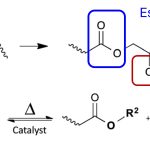
The last post introduced vitrimers. This post will provide more detailed information regarding the chemistry of the covalent adaptive networks in vitrimers. In Leibler’s pioneering work, the cured network contained a covalent adaptive network (CAN). Figure 1. Schematic approach to vitrimers [1] In Figure 1, there are two types of covalent adaptive networks ... [Click to Continue...]
Thermoset Re-use and Recycling – Part Two
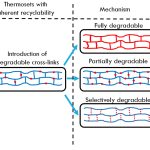
There are many emerging approaches to chemically recycling thermoset resins. This post will present an overview of the current approaches to address the end-of-life considerations in thermoset materials. Figure 1 shows a schematic of the various approaches used to address the thermoset recycling challenge. Figure 1. High level chemical recycling pathways [1] The ... [Click to Continue...]
Thermoset Re-use and Recycling – Part One
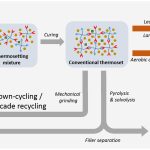
This post is part one of a multiple part series on the topic of end-of-life considerations for thermosets. There is currently a lot of discussion in the press regarding recycling, ocean plastic, littering, and other considerations regarding how to handle plastics after their original use. This series will focus only on thermosets, which up until recently have been only ... [Click to Continue...]